
A desert safari should be a rush, not a gamble. In Dubai’s vast dunes, the line between a world-class adventure and a preventable emergency usually comes down to one thing: is your tour operator actually licensed and safety-first, or just cutting corners?
This isn’t just about paperwork. The desert is unforgiving; shifting soft sands, steep slip faces, and extreme heat leave no room for error. Recognizing this, Dubai’s tourism regulators have implemented strict standards for health, safety, and transport that every camp must follow.
It’s a big deal. Dubai Tourism reports that nearly 20% of all visitors include a desert trek in their itinerary. When an activity is that fundamental to the city’s identity, professional regulation isn’t just red tape; it’s the vital framework that separates serious professionals from those gambling with your safety.
If you are booking a desert safari, dune buggy tour, or red-dune ride near the Lehbab Desert, this guide will show you what really matters: licensing, mechanical reliability, trained people, insurance clarity, and environmental responsibility.
When an operator is “DTCM licensed,” it means they operate under Dubai’s Department of Economy and Tourism (DET) regulatory system. This isn’t just a badge; it’s a strict framework.
The authority evaluates operators on:
A licensed operator is accountable. They are visible to regulators and tied to standards that are actually audited.
The biggest safety risks in the desert are not always dramatic. They are often quiet failures that build in the background until the terrain exposes them.
Dubai Police and the Roads and Transport Authority (RTA) frequently issue severe summer warnings regarding tire safety, noting that extreme UAE temperatures can cause underinflated or aging tires to fail catastrophically. The RTA even strictly bans tires older than five years on regular roads. In the desert, where sand temperatures soar even higher and tires are intentionally deflated for traction, those baseline weaknesses become exponentially more dangerous. On flat city roads, a failing tire is bad enough; on a dune face, it can instantly destroy stability, steering confidence, and braking control.
Local traffic authorities consistently remind UAE motorists that intense summer heat rapidly accelerates the degradation of rubber belts and hoses, making cooling system inspections critical. In desert driving, that is not a small maintenance item. A neglected hose, weak connection, or cooling failure can mean sudden overheating in remote terrain, loss of power, or a stranded vehicle with guests exposed to extreme heat.
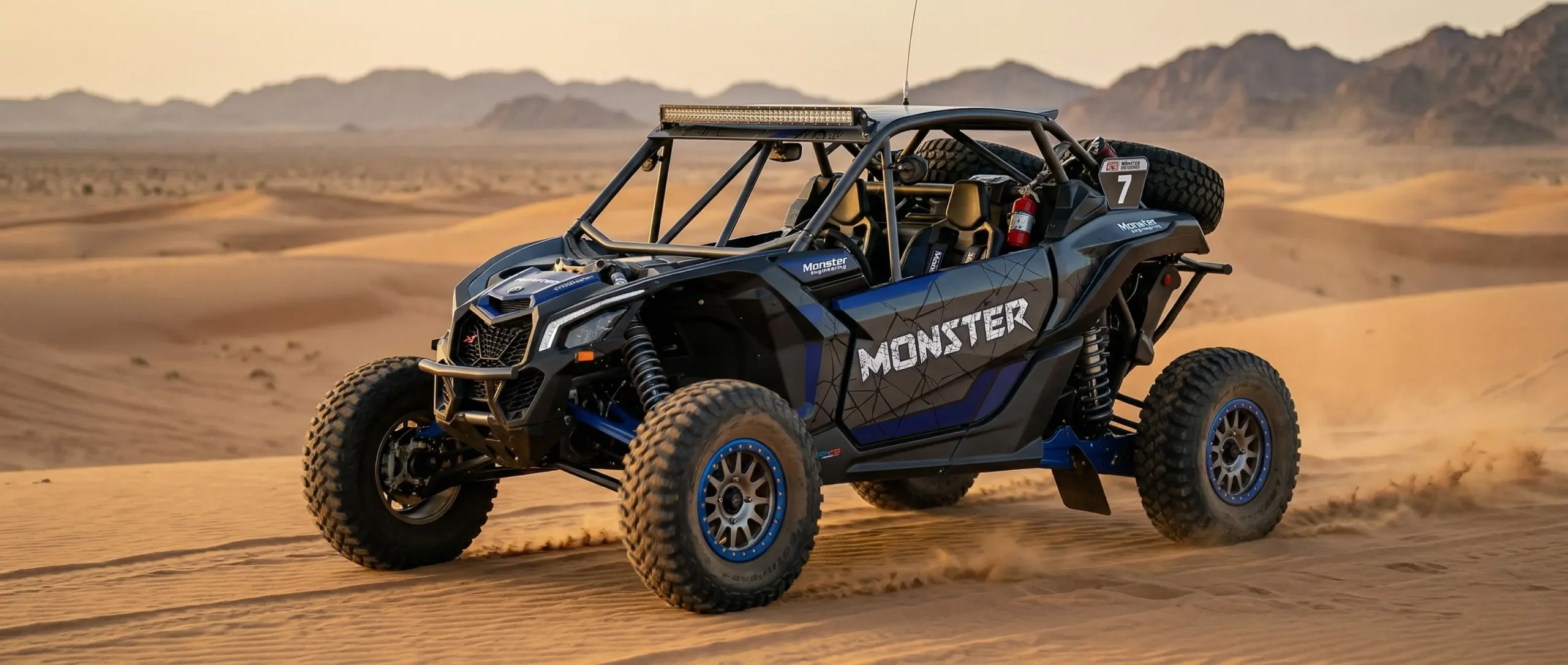
Desert machines should be built and prepared for off-road rollover risk, impact, and occupant restraint. That means proper structural protection such as a roll cage, secure seating, and real harness systems rather than basic automotive assumptions. Monster Experience’s own equipment pages highlight doors, roll cages, and four-point harnesses, while also noting that safer family-oriented buggies use full roll cages and four-point or five-point restraints. That is the kind of language you want to see from a serious operator, because it shows an understanding that dune driving is not regular road driving.
Dubai’s desert regulations require drivers to complete tour guide certification, deliver mandatory safety briefings, and hold the correct RTA licenses. That is crucial because the desert punishes ego. Reading soft ridgelines, approaching crests correctly, managing convoy spacing, and knowing when not to attempt a line are skills. A cheap operator with an “adventure guy” behind the wheel is not the same thing as a professional guide.
Dubai’s regulations explicitly evaluate desert operators on insurance coverage, and the UAE government recognizes liability insurance as a formal insurance category under a regulated insurance sector supervised by the Central Bank of the UAE. If an operator cannot clearly explain its public liability insurance, you may be stepping into an avoidable legal mess.
The hard truth is this: the desert is unforgiving, but most serious safari accidents do not begin with the dunes. They begin with hidden neglect.
A safe desert safari starts long before the engine fires up. It starts in the workshop, on the inspection sheet, and in the operator’s willingness to retire, repair, and service vehicles before guests ever arrive.
The Dubai RTA’s annual ‘Summer Without Accidents’ campaign guidance is blunt: inspect belts and hoses for cracking, verify coolant condition, check battery health, and rigorously inspect tires for heat damage before travel. Those baseline road recommendations matter even more in desert operations, where continuous load, hot ambient conditions, and sand resistance place extreme strain on the vehicle. In the dunes, a weak cooling system is not just inconvenient, and a worn tire is not just an expense deferred. Both can become emergency triggers.
That is why credible operators talk openly about fleet quality and service routines. This is why our entire fleet consists of brand-new Can-Am buggies that are regularly serviced at an official center and why its facilities include technical support, garage storage, vehicle washing after each ride, and refueling support. It also describes vehicles equipped with doors, a roll cage, and 4-point safety harnesses, supported by a safety debrief and operating instructions before the ride.
Those details matter because true off-road safety is layered. A roll cage helps preserve occupant space if a vehicle tips. Four-point harnesses hold the body more securely than casual restraints when the buggy pitches, lands, or slides sideways. Proper doors, reinforced suspension, and stability-oriented platforms matter because the loads in dune driving are not linear; they shift quickly and often violently. Monster Experience’s buggy guide also notes that four-seater models prioritize safety and comfort and are designed with full roll cages and harness systems suited to family use.
A professional operator should also be able to explain what pre-ride checks happen every day, what happens after each ride, and which vehicles are matched to beginners versus advanced riders. If that conversation is vague, your risk is already rising.
The guide is not there for decoration. In a real desert operation, the guide is part driver, part safety controller, part route reader, part recovery specialist, and part risk manager.
Dubai’s desert regulations make that philosophy explicit. The rules say drivers must complete tour guide certification, give mandatory safety briefings, and hold the correct licenses. That tells you something important about how Dubai views desert safaris: not as joyrides, but as managed tourism activities requiring trained personnel. –
The difference between professional guidance and amateur driving becomes even more obvious in red-dune terrain such as the Lehbab Desert and Al Lahbab/Al Badayer zones that operators commonly promote. On these dunes, experience shows up in subtle choices: how the convoy enters a bowl, where the vehicle crosses a ridge, when a passenger should be repositioned, when a beginner should slow down, and when a route should be abandoned because the sand has shifted. Monster Experience describes its tours as being led by expert instructors and says its guides are trained in first aid and off-road recovery, with a published guide-to-guest ratio of 1:3 on dune buggy experiences.
This is where certified off-road guides and first-aid certification stop being buzzwords and start becoming your margin of safety. A proper guide screens for health restrictions, delivers a usable briefing, watches body language, controls pace, and knows what to do if someone panics, a vehicle bogs down, or a passenger shows signs of heat stress. An amateur driver may be exciting for ten minutes. A professional guide gets everyone home.
Most guests think about insurance only after something goes wrong. That is backwards.
Dubai’s own desert tour regulations list insurance coverage among the categories operators are evaluated on. Separately, the UAE government’s official insurance guidance confirms that liability insurance is a recognized insurance category under a sector supervised and regulated by the Central Bank of the UAE. Major UAE insurers such as ADNIC describe corporate liability coverage as including public and products liability and note that such policies help protect businesses against financial loss from claims.
Why does that matter to you as a guest? Because an accident without clear public liability insurance can turn into a legal and financial maze. Instead of dealing with a defined insurer-backed claims process, you may be left trying to establish which company actually operated the tour, whether that entity has the financial capacity to respond, what exclusions apply, and how responsibility is allocated for guest injury or third-party damage. That is stressful in any country. In a foreign jurisdiction, after a desert accident, it is the last problem you want.
A professional operator should be able to explain, in plain language, what is covered, what is not covered, and what emergency procedures activate if a guest is injured. If the answer is evasive, rushed, or inconsistent, treat that as a warning sign, not a paperwork issue.
Safety and environmental responsibility belong together. Operators that disrespect the desert often cut corners elsewhere too.
Dubai’s desert regulations specifically mention the implementation of environmentally sustainable practices. That is not cosmetic. The desert is a living ecosystem, not an empty playground. The Dubai Desert Conservation Reserve describes itself as protecting Dubai’s last desert wilderness and native plants and animals and says its mission is to rewild habitat so indigenous species can thrive again. The reserve is also positioned as a destination for authentic and sustainable nature-based experiences. – –
In practical terms, responsible desert touring means controlled routing, avoiding reckless off-track driving, respecting protected habitats, minimizing litter and fuel contamination, and training guests not to treat every dune as a stunt arena. That matters in conservation areas, and it also matters in popular adventure zones around the red dunes, including routes marketed around the Lehbab Desert experience. –
Monster Experience’s published mission includes delivering adventures that are “safe, sustainable, and unforgettable,” which is the right framework. The best safari operators understand that preserving the dunes is not anti-adventure. It is what keeps the adventure worth having.
If you want to book smart, verify first. Dubai gives consumers a practical starting point: the official Invest in Dubai license search allows users to search by license number, Dubai Unified License number, or business name. Dubai’s tourism portal also confirms that the ePermits system covers safari drivers, vehicles, desert camps, and tour operator counters
Use this checklist before you pay:
A trustworthy company will not be irritated by these questions. A serious operator expects them.
The desert is one of the most beautiful environments on Earth, but it is also one of the most unforgiving. As this guide illustrates, a safe safari doesn’t happen by accident it is the result of rigorous maintenance, specialized equipment, and professional accountability.
In Dubai, “licensed” is more than just a legal requirement; it is your guarantee that an operator has invested in your survival. From reinforced roll cages and four-point harnesses to RTA-certified guides and comprehensive liability insurance, these standards are what allow you to focus on the thrill of the dunes rather than the risks of the terrain.
When booking your next adventure, remember that the cheapest option often cuts the most critical corners. By choosing a high-standard operator like Monster Experience, you aren’t just booking a ride; you are securing peace of mind.
Don’t leave your safety to chance. Experience the red dunes with the confidence that only professional standards, elite equipment, and expert guiding can provide.