
To understand the dune buggy, we have to look before the legend. In the late 1950s and early 1960s, Southern California surfers needed a way to navigate deep, soft beach sand to reach remote waves. Initially, they stripped the heavy metal bodies off old 1930s street cars, welded on wider tires, and created crude, heavy machines known as “water pumpers” because they still used water-cooled V8 engines which were prone to overheating in the slow, hot sand.
While many credit Bruce Meyers with inventing the dune buggy, Meyers himself once clarified: “I didn’t invent the dune buggy… I invented this style of dune buggy.” The late 1950s saw pioneers like Pete Beirning, who in 1958 took a rolled Volkswagen Beetle and shortened its floor pan to create a more nimble sand car.
Following that came the EMPI “Sportster,” the first production buggy kit made largely of heavy tube frames and sheet metal, and later, Hilder “Tiny” Thompson’s aluminum-based “Burro.” These early sand cars were highly functional, but they were boxy, agricultural, and entirely lacked style. They were tools, not icons.
Enter Bruce Meyers, an artist, surfer, and skilled boat builder. Meyers knew from his maritime experience that a sleeker, lighter, and more stylish body could be crafted from fiberglass. In 1964, in a garage in Newport Beach, California, he built his first prototype, affectionately named “Old Red.”
Initially, Meyers built 12 “Monocoques”—vehicles with their own fiberglass floor and molded mount castings that bolted directly to VW engine and suspension components. While structurally innovative, these were incredibly expensive and difficult to manufacture. Realizing he needed a more accessible product, he quickly redesigned the body to fit perfectly onto a shortened VW floor pan.
To create a Meyers Manx, builders had to cut exactly 14.5 inches out of a standard Volkswagen Beetle chassis. This shortened wheelbase dramatically improved the car’s agility and power-to-weight ratio, making it virtually unstoppable off-road.
The result was a lightweight machine that perfectly encapsulated the carefree, adventurous spirit of 1960s surf culture. It wasn’t long before the company was producing nearly 6,000 Manx kits. By 1969, a massive buggy boom had taken over the United States, with over 225 different body styles created by various companies attempting to replicate Meyers’ iconic design.
The buggy wasn’t just a stylish beach cruiser; it was a serious mechanical competitor. The defining moment of its history occurred during the record-breaking run that would inspire the legendary Baja 1000.
In April 1967, Bruce Meyers and co-driver Ted Mangels took “Old Red” deep into the unforgiving Baja California desert to attempt a speed record from Tijuana to La Paz. The existing record was held by motorcycles, which were considered the kings of the desert.
Competing against the clock and rough terrain, the lightweight, rear-engine buggy performed astonishingly well. It floated over the sand and navigated rocky terrain with such agility that Meyers and Mangels completed the run in 34 hours and 45 minutes.
This shattered the previous motorcycle record of 39 hours and 56 minutes by more than five hours. The victory proved to the world that the dune buggy was a formidable motorsport machine.
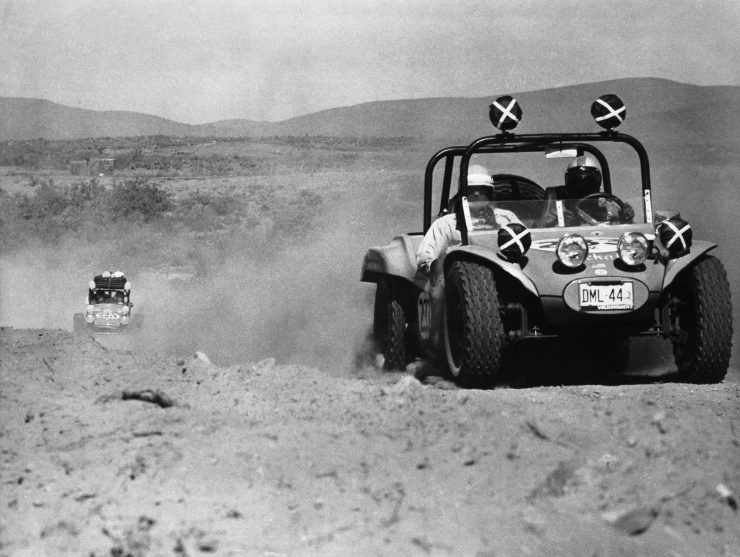
“Old Red” navigating the brutal terrain of Baja California. Source: Silodrome
This feat directly led to the formation of the National Off-Road Racing Association (NORRA) and the first official “Mexican 1000” race in November 1967. In that inaugural race, a Meyers Manx driven by Ted Mangels and Vic Wilson won outright, beating all motorcycles and 4x4s with a time of 27 hours and 38 minutes.
Unfortunately, the initial boom ended almost as quickly as it began. The success of the Manx spawned an army of imitators. Companies like Sears and Roebuck began selling cheap fiberglass copies, undercutting Meyers’ business.
Meyers fought a patent infringement battle to protect his design, but a judge ruled that the design was “obvious” and unpatentable, opening the floodgates for clones. Simultaneously, strict 1970 motor vehicle laws requiring closed fenders and covered engines, combined with IRS tax demands, created a perfect storm.
The original B.F. Meyers & Co. was forced to close its doors in 1971. While the business failed, the culture it created was unstoppable. The buggy had already cemented itself as an icon of American freedom.
For decades, original Manx buggies became prized collector’s items. But true icons rarely stay dormant. In 1999, Bruce Meyers revived the company, kicking off a resurgence that brought the fiberglass buggy back to the forefront of automotive enthusiast culture.
In 2020, shortly before his passing in 2021 at age 94, Bruce Meyers sold the company to Trousdale Ventures. The new ownership hired legendary designer Freeman Thomas (designer of the Audi TT and New Beetle) to shepherd the brand into the future.
Celebrating its 60th anniversary, the newly reorganized company officially showcased the “Meyers Manx 2.0″—a fully modernized, all-electric version of the classic buggy.
The Meyers Manx 2.0 Electric Vehicle. Source: Autoweek
| Feature | Specification |
|---|---|
| Battery Options | 20 kWh or 40 kWh |
| Range | 150 to 300 miles (estimated) |
| Horsepower | 202 hp (40 kWh model) |
| Acceleration | 0-60 mph in 4.5 seconds |
| Weight | 1,500 – 1,650 lbs |
| Construction | Aluminum monocoque |
Swapping the noisy air-cooled VW engine for a high-tech battery pack, the new EV proves that the timeless design of the 1960s is just as relevant in the modern era.
While the Meyers Manx forged the path in California, the modern pinnacle of off-road buggy culture is happening thousands of miles away, deep in the United Arab Emirates. The stories trapped in the sandy tires of that museum artifact are being rewritten every day on a grand scale through world-class Dubai dune buggy tours.
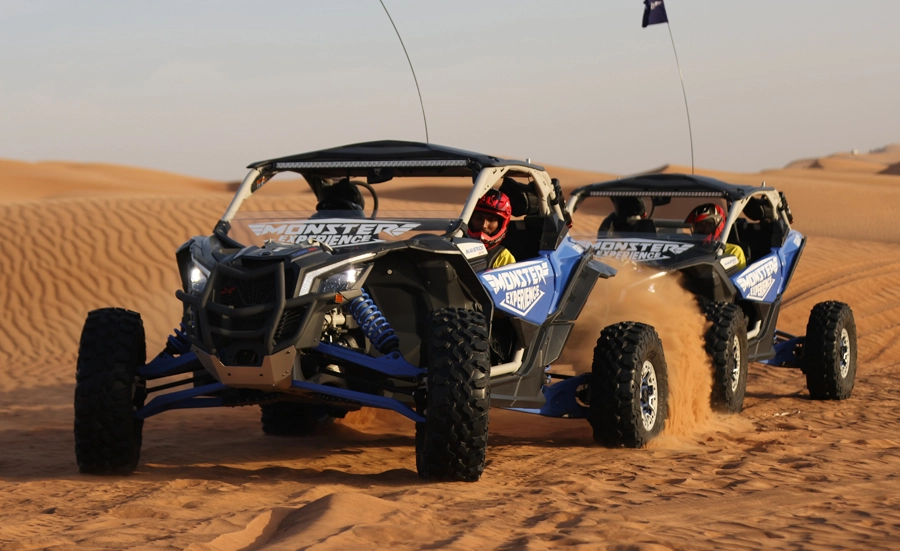
Modern dune buggies tackling the red dunes of Lahbab, Dubai. Source: Dune Buggy Dubai
If looking at automotive history makes you crave the adrenaline of the open desert, Dubai is where you can experience the modern evolution of off-roading. Operators in the famous Lahbab (Red Dunes) and Mleiha deserts have traded the simple VW pans for aggressive, high-performance engineering designed specifically to conquer towering dunes.
When you book a dune buggy adventure in Dubai, you are stepping into highly advanced machines. Modern tour operators utilize heavy-duty vehicles such as:
Unlike the open-air risks of the 1960s, today’s tours prioritize absolute safety. Vehicles are outfitted with reinforced steel roll cages, 4-point racing harnesses, helmets, and goggles. Tours typically range from 700 AED to 2,500 AED ($190 – $680 USD) depending on the vehicle power and duration.
What’s Included? Most premium packages are comprehensive experiences involving:
The dune buggy has transcended its status as a simple recreational vehicle to become a global symbol of specialized engineering.
Planning to experience the legacy yourself? Whether in Baja or Dubai, follow these expert tips:
The original dune buggy may sit quietly under museum glass, but its adventurous soul is alive, kicking up red sand under the blazing Arabian sun and winding through California trails. From Pete Beirning’s crude water pumpers to Bruce Meyers’ artistic revolution, and now to the electric future and high-performance desert tourism, the buggy represents a timeless human desire: the urge to go where the road ends.
History isn’t just meant to be looked at behind glass; it’s meant to be driven.
A traditional dune buggy (like the Manx) is usually based on a modified car chassis (often a VW Beetle) with a fiberglass body. A sand rail is a purpose-built, tube-frame vehicle with no body panels, designed specifically for high-performance sand dune driving. Sand rails are typically lighter and more powerful.
Yes, most vintage Manx buggies are street legal because they retain the VIN and chassis registration of the original donor Volkswagen Beetle. However, modern laws vary by state and country regarding kit car registration.
Yes, for self-drive buggy tours in Dubai, operators almost always require a valid driver’s license from your home country. Passengers do not need a license.
The new Meyers Manx 2.0 EV is estimated to accelerate from 0 to 60 mph in just 4.5 seconds, making it significantly faster than the original air-cooled VW versions.