

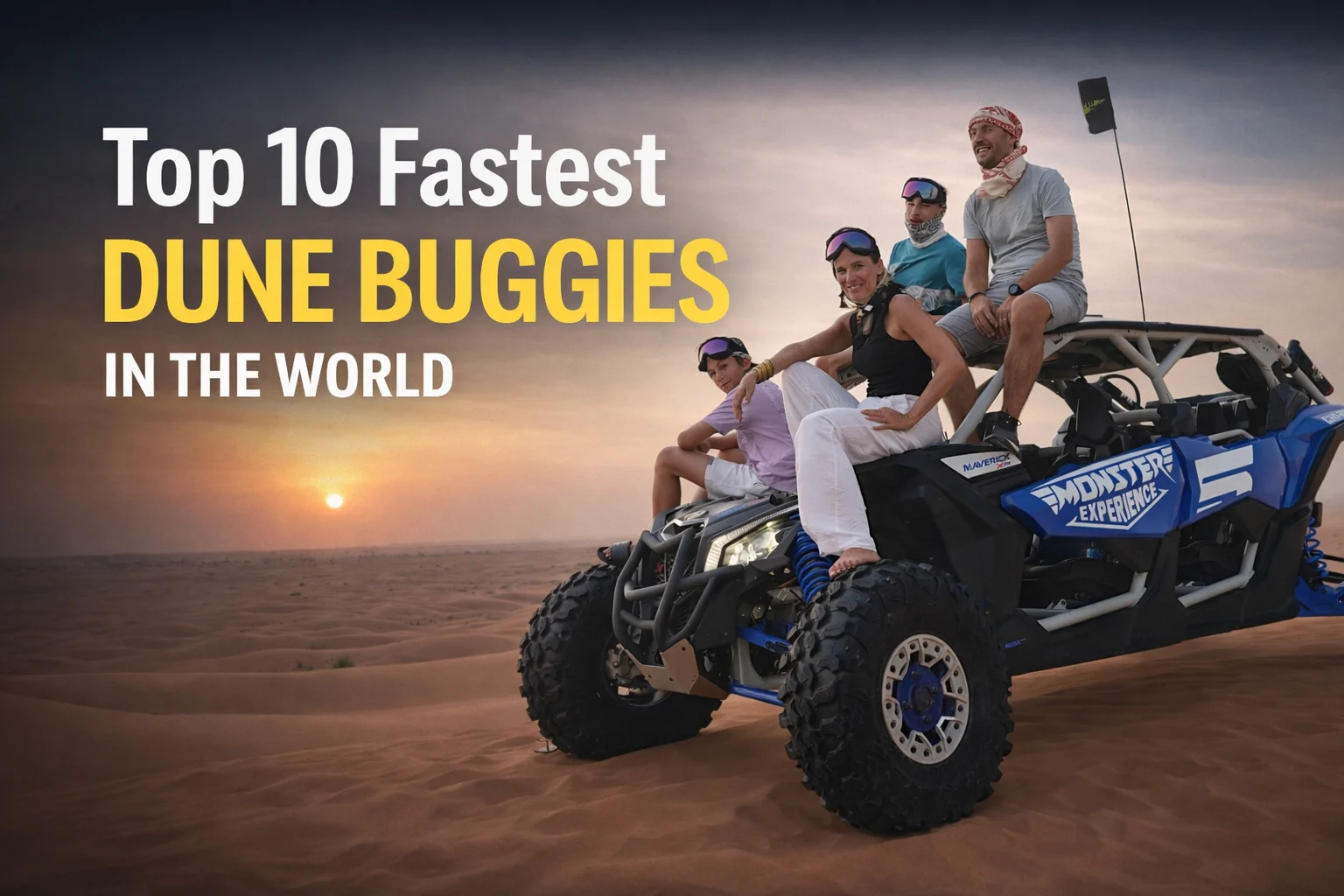
The desert doesn’t forgive hesitation. Out on the dunes, whether you’re carving lines through the Liwa desert in Abu Dhabi or blasting over the legendary sand mountains of Glamis, California, speed is currency. But not all speed is equal. The fastest dune buggies in the world combine blistering horsepower, surgical suspension engineering, and a power-to-weight ratio that makes sports cars look lazy.
This is your definitive 2026 guide to the ten fastest dune buggies on the planet. We’re talking exact top speeds, dyno-verified horsepower, 0–60 mph times, and the engineering details that separate the record-breakers from the merely fast. Whether you’re in the market for your next machine or just want to understand what you’ll be strapping into on your next desert experience in Dubai, this is the only list you need.
Raw horsepower is only one piece of the puzzle. A 1,000 hp drag car would bury itself axle-deep in soft sand within seconds. True dune speed is a multi-variable equation, and here are the variables that matter most.
This is the single most important metric for off-road performance. A lighter buggy with a modestly powerful engine will outrun a heavier machine with twice the horsepower on loose terrain. Elite sandcars target a power-to-weight ratio of 1 hp per 3 lbs or better, the kind of numbers that produce genuine, scary acceleration on a dune face.
The fastest dune buggies aren’t rigid they’re fluid. Long-travel suspension systems (often 20–24+ inches of wheel travel) allow the vehicle to absorb massive terrain impacts without transferring the energy to the chassis or driver. This means you can stay pinned on the throttle over terrain that would send a lesser machine airborne in the worst possible way. More suspension travel equals more speed through the rough.
On a flat road, peak horsepower wins drag races. On shifting sand, torque — the rotational force available across the entire RPM range — determines whether you climb a 60-degree face or dig a hole. Low-end torque gets you moving through deep, soft sand. It also means your continuous variable transmission (CVT) the preferred transmission type for virtually all modern performance UTVs can keep the engine in its power band regardless of terrain change.
Unlike a conventional automatic or manual gearbox, a CVT offers an infinite ratio of gear steps between its lowest and highest settings. This keeps the engine operating at peak efficiency at all times, translating every horsepower into forward momentum with minimal loss. In sand driving, where speed and resistance change constantly, CVT technology is a genuine performance advantage.
The top machines on this list use forced induction turbochargers to extract power from small-displacement engines that would otherwise be too heavy for their output. Turbocharging allows a 900cc or 1,000cc engine to produce 200+ horsepower while remaining light enough to maintain an exceptional power-to-weight ratio.
Wide, aggressive paddle tires provide the biting surface that translates engine output into actual forward movement on sand. Without the right tires, even the world’s fastest buggy goes nowhere. Proper paddle tires are optimized for sand displacement, running pressure, and flotation; they’re as important to dune speed as the engine itself.
| Rank | Buggy | Top Speed (mph) | Horsepower | Engine | 0–60 mph |
|---|---|---|---|---|---|
| 1 | Chenowth Racing LRSC | 110+ mph | 650+ hp | Custom V8 | ~2.5 sec |
| 2 | Jimco Motorsports Class 1 | 130 mph | 500+ hp | 2.0L Turbo 4-cyl | ~3.0 sec |
| 3 | PKT Trophy Truck Spec | 120 mph | 450 hp | 2.0L Turbo 4-cyl | ~3.2 sec |
| 4 | Hammerhead Off-Road Titan X | 75 mph | 300 hp | 1.0L Triple Turbo | ~4.5 sec |
| 5 | Can-Am Maverick X3 X RS Turbo RR ⭐ | 72 mph | 200 hp | 900cc Turbo 3-cyl | ~4.4 sec |
| 6 | Polaris RZR Pro R ⭐ | 80 mph | 225 hp | 2.0L NA 4-cyl | ~4.5 sec |
| 7 | Polaris RZR Turbo R | 75 mph | 181 hp | 925cc Turbo 4-cyl | ~5.0 sec |
| 8 | Kawasaki Teryx KRX 1000 | 72 mph | 112 hp | 999cc NA 4-cyl | ~6.0 sec |
| 9 | Yamaha YXZ1000R SS SE | 70 mph | 112 hp | 998cc NA 3-cyl | ~6.5 sec |
| 10 | Honda Talon 1000X-4 | 70 mph | 104 hp | 999cc NA 4-cyl | ~6.8 sec |
⭐ = Available in the Monster Experience fleet in Dubai
Top Speed: 110+ mph | Horsepower: 650+ hp | Engine: Custom V8 (various configs) | 0–60 mph: ~2.5 seconds
The Chenowth LRSC is a military-developed machine that has been terrorizing deserts since the 1980s. Modern custom builds based on this platform push V8 power into sand car territory that borders on insanity. These are not production vehicles — they’re hand-built weapons, with tube-chassis construction, racing-spec suspension, and power-to-weight ratios that rival open-wheel race cars. The torque from a built V8 in a sub-1,500 lb chassis is a genuinely transformative experience. Only for experienced drivers with access to open desert.
Top Speed: 130 mph | Horsepower: 500+ hp | Engine: 2.0L Turbocharged 4-cylinder | 0–60 mph: ~3.0 seconds
Jimco is the gold standard for purpose-built racing sand cars. Their Class 1 machines — eligible for the Baja 1000 and similar desert events — are engineering masterpieces. With over 20 inches of suspension travel, tubular chromoly construction, and engines that push 500+ horsepower through a race-spec sequential gearbox, these represent the absolute pinnacle of what a dedicated sand car can be. The power-to-weight ratio is extraordinary, and the turbocharging setup keeps power delivery progressive and controllable even at triple-digit speeds.
Top Speed: 120 mph | Horsepower: 450 hp | Engine: 2.0L Turbocharged 4-cylinder | 0–60 mph: ~3.2 seconds
PKT builds race-bred machines that bridge the gap between full Trophy Trucks and production UTVs. Trophy Truck Spec buggies feature independent rear suspension, massive shock absorbers, and turbocharged engines that deliver consistent power from low RPM all the way to redline. The CVT-equipped versions are particularly impressive for sand performance — the transmission keeps the turbo engine in its boost threshold at all times, meaning every sand face gets attacked with full torque on tap.
Top Speed: 75 mph | Horsepower: 300 hp | Engine: 1,000cc Triple Turbo | 0–60 mph: ~4.5 seconds
Hammerhead’s Titan X is a reminder that innovation in the UTV space is accelerating rapidly. The triple-turbo configuration is unusual — and effective. The staged boost delivery means usable torque from nearly idle speed, which translates directly into confident dune performance. With 300 hp in a sub-1,500 lb chassis, the Titan X punches well above its price point and offers serious competition for the established brands. Suspension travel of 22 inches front and rear means it handles chop and whoops at speed without drama.
Top Speed: 72 mph | Horsepower: 200 hp | Engine: 900cc Rotax Turbocharged 3-cylinder | 0–60 mph: ~4.4 seconds
This is arguably the most significant production UTV ever built — and it’s available right here in Dubai through Monster Experience. The Can-Am Maverick X3 X RS Turbo RR redefined what a production side-by-side could do when it launched, and it remains the benchmark against which all other UTVs are measured.
The 900cc Rotax turbocharged triple-cylinder engine produces a class-leading 200 horsepower in a package that weighs just 1,647 lbs. That’s a power-to-weight ratio of approximately 1 hp per 8.2 lbs — exceptional for a production vehicle. The 0–60 time of approximately 4.4 seconds puts it in the same bracket as performance sports cars.
What makes the X3 truly special for desert driving is the combination of that turbocharged torque curve, the Smart-Lok front differential, and 20 inches of front suspension travel with 22 inches at the rear. The FOX 3.0 Podium RC2 shocks soak up brutal terrain at speeds that would destroy lesser machines. In Dubai’s desert conditions — deep, soft sand and steep dune faces — the X3’s low-end torque delivery through the CVT is magnificent. You feel the boost arrive, the wheels dig in, and the machine simply climbs.
The Maverick X3 is not just a fast buggy. It’s a refined, capable, and genuinely thrilling machine that makes expert-level desert performance accessible to motivated enthusiasts.
Top Speed: 80 mph | Horsepower: 225 hp | Engine: 2.0L Naturally Aspirated 4-cylinder (ProStar) | 0–60 mph: ~4.5 seconds
Polaris answered the Can-Am challenge with their most ambitious machine ever: the RZR Pro R. And they did something remarkable — they achieved 225 hp without a single turbocharger. The naturally aspirated 2.0L ProStar engine breathes freely through a high-flow air intake, revs enthusiastically, and delivers power that feels linear and immediate rather than boost-dependent.
The 225 hp output is the highest of any naturally aspirated production UTV engine, and the absence of turbo lag means the power is always there when you need it — a genuine advantage in technical dune terrain where you’re constantly modulating throttle. The RZR Pro R also features a 72-inch stance (the widest of any production RZR) and 22 inches of front suspension travel, making it extraordinarily stable at speed over rough terrain.
Also available in the Monster Experience fleet, the Pro R offers a slightly different character to the Can-Am: taller, wider, naturally aspirated, and arguably easier to manage for drivers still developing their desert skills. At 80 mph top speed on the correct terrain, it’s no slouch — and in the dunes of Dubai, the Pro R’s generous suspension travel and progressive power delivery make it a joy to drive at pace.
Top Speed: 75 mph | Horsepower: 181 hp | Engine: 925cc Turbocharged 4-cylinder | 0–60 mph: ~5.0 seconds
The standard-bearer of the RZR lineup before the Pro R arrived, the Turbo R remains a serious machine. The 925cc turbocharged engine produces 181 hp — more than enough to make the dunes feel genuinely fast. With 20 inches of suspension travel and Fox shocks, it handles harsh terrain well. The CVT keeps the boosted engine in its power band effectively, and the lighter overall weight compared to some competitors gives it an edge in responsiveness. An excellent starting point for anyone entering high-performance UTV territory.
Top Speed: 72 mph | Horsepower: 112 hp | Engine: 999cc Naturally Aspirated Parallel-Twin | 0–60 mph: ~6.0 seconds
Kawasaki built the KRX 1000 as a premium, highly capable trail machine, but it performs admirably in sand as well. The parallel-twin engine delivers strong mid-range torque relative to its displacement — a characteristic that matters enormously on dunes. With 24 inches of rear suspension travel (among the highest in its class), the KRX absorbs punishment over rough terrain and stays composed at its top speed. Less explosive than turbocharged competitors, but a polished and reliable performer.
Top Speed: 70 mph | Horsepower: 112 hp | Engine: 998cc Naturally Aspirated 3-cylinder | 0–60 mph: ~6.5 seconds
Yamaha took a different approach with the YXZ1000R — it’s the only production sport UTV with a true manual transmission (sequential Sport Shift). That changes the driving experience fundamentally. You’re actively managing gears, choosing when to be in the powerband, and engaging with the machine in a way that CVT-equipped rivals don’t offer. The 998cc triple revs freely and sounds extraordinary at full throttle. With 18 inches of suspension travel, it’s slightly less compliant over big hits than the top-tier machines but rewards skilled drivers enormously.
Top Speed: 70 mph | Horsepower: 104 hp | Engine: 999cc Naturally Aspirated Parallel-Twin | 0–60 mph: ~6.8 seconds
Honda’s entry into the performance UTV space brought the brand’s legendary reliability to a segment that wasn’t always associated with that virtue. The Talon 1000X-4 (4-seat variant) features Honda’s Automatic DCT dual-clutch transmission — offering the shift control of a manual with the convenience of an automatic. Suspension is impressive: 18.7 inches front and 19.9 inches rear. The engine prioritizes broad, usable torque over peak power figures, which actually serves dune driving very well. An excellent choice for those who value long-term durability alongside performance.
Here’s the truth that top-speed statistics don’t tell you: in the actual dunes of the UAE — the rolling red sands of the Hajar foothills, the legendary Liwa desert mega-dunes of the Empty Quarter, the popular dune belts around Al Qudra — straight-line top speed is almost never the relevant variable.
Dubai’s desert terrain is characterized by constantly shifting dunes. Wind patterns change the faces overnight. What was a gentle approach one morning becomes a steep, soft-faced wall by afternoon. The sand composition varies — from coarser, firmer surfaces near the base of dunes to the fine, almost liquid-feeling sand at the crests.
In these conditions, torque and suspension travel matter infinitely more than peak top speed.
Here’s why:
Torque determines whether your buggy climbs a steep dune face or digs itself in. When you crest a dune and your speed drops as the resistance increases, you need engine torque available immediately — not at 6,000 RPM. The Can-Am Maverick X3’s turbocharged Rotax engine produces peak torque low in the rev range, and the CVT keeps it there. This is what makes it so effective in Dubai’s terrain. The Polaris RZR Pro R’s naturally aspirated engine trades boost-dependent torque for linear response — also effective, just differently so.
Suspension travel determines whether you can carry speed over the terrain, or whether every undulation forces you to lift off the throttle. With 20–22 inches of travel and properly tuned FOX shocks, the Monster Experience fleet vehicles can be driven at confident, committed pace over ground that would require a crawl in a standard SUV. The suspension absorbs the energy; you stay focused on the next dune.
In practical terms, most experienced dune drivers in Dubai will rarely exceed 60–65 mph — not because the machines can’t go faster, but because intelligent desert driving means reading the terrain, managing momentum efficiently, and knowing when to build speed and when to scrub it. The reward for driving at this level isn’t just safety — it’s the extraordinary sensation of a high-powered machine working perfectly with the landscape, which is more thrilling than any speedometer reading.
Reading about these machines is one thing. Feeling 200 horsepower launch you up a 30-metre dune face while the suspension works beneath you — that’s something no article can fully convey.
At Monster Experience (monster-experience.com), we operate a fleet of the world’s best production off-road buggies — including the Can-Am Maverick X3 X RS Turbo RR and the Polaris RZR Pro R in the spectacular dune landscapes around Dubai.
Our guided desert safari experiences are built for enthusiasts. You’ll receive a full vehicle briefing covering controls, CVT behavior, throttle management on sand, and dune approach techniques before you ever turn a wheel in anger. Our routes take you through terrain that has been specifically selected to showcase what these machines can do — crests, bowl turns, steep faces, and long flat-out sections where you can feel the full acceleration that 200+ horsepower produces in the desert.
Whether you’re visiting Dubai and want a genuine adrenaline experience, or you’re a resident looking to push yourself in one of the world’s finest performance UTVs, Monster Experience delivers the real thing.
Book your experience: monster-experience.com